
Before We Begin
For most of my professional life, I have argued that digital privacy is not a right under siege but an illusion under management. The comforting story we tell ourselves is that encryption, regulation, and corporate "privacy commitments" are locked doors, occasionally rattled by overreaching governments and overcurious corporations. The historical and technical record suggests something far starker: the house was built without walls.
On January 22, 2026, Forbes reporter Thomas Brewster documented that Microsoft had handed BitLocker recovery keys to the FBI so agents could decrypt data on seized Windows laptops, relying on keys users had been encouraged to escrow to Microsoft's cloud for "convenience."[*] This is not a novel aberration. It is a contemporary expression of a pattern that runs from the Clipper Chip to BULLRUN, from PRISM to cloud "partnerships," from hardware backdoors to state-funded anonymity networks. Each episode reinforces the same structural fact: when the architecture is designed to preserve state visibility, your "choice" about privacy is largely ceremonial.
This paper is my attempt to treat that fact not as a conspiracy theory or a cynical slogan, but as a system to be mapped. I trace how intelligence agencies, legislators, and technology companies have co-evolved the global digital stack, including hardware, protocols, cloud platforms, and "secure" apps, around persistent, multi-layered access paths that are then obscured by legal secrecy and security theater. Along the way, I argue that carefully staged public conflicts over encryption, and the commercialization of tools marketed as liberation from surveillance, function primarily as perception management rather than resistance.
Readers should not come to these pages looking for comfort, nor for operational security "tips and tricks" that magically opt them out of this environment. Instead, my goal is to replace superstition with structure: to show that what often feels like random intrusion is in fact the predictable behavior of a networked state that has normalized total visibility as a prerequisite for its own survival. The BitLocker case is simply the news peg that made it socially acceptable to say aloud what the infrastructure has been saying for decades: privacy was never the product. It was always the interface.
If this work succeeds, it will not be because you agree with every inference or embrace every conclusion, but because you finish it unable to see "privacy features" as anything other than components in a larger panopticon. Once you see the glass, you can at least decide how you will live inside it.
Abstract
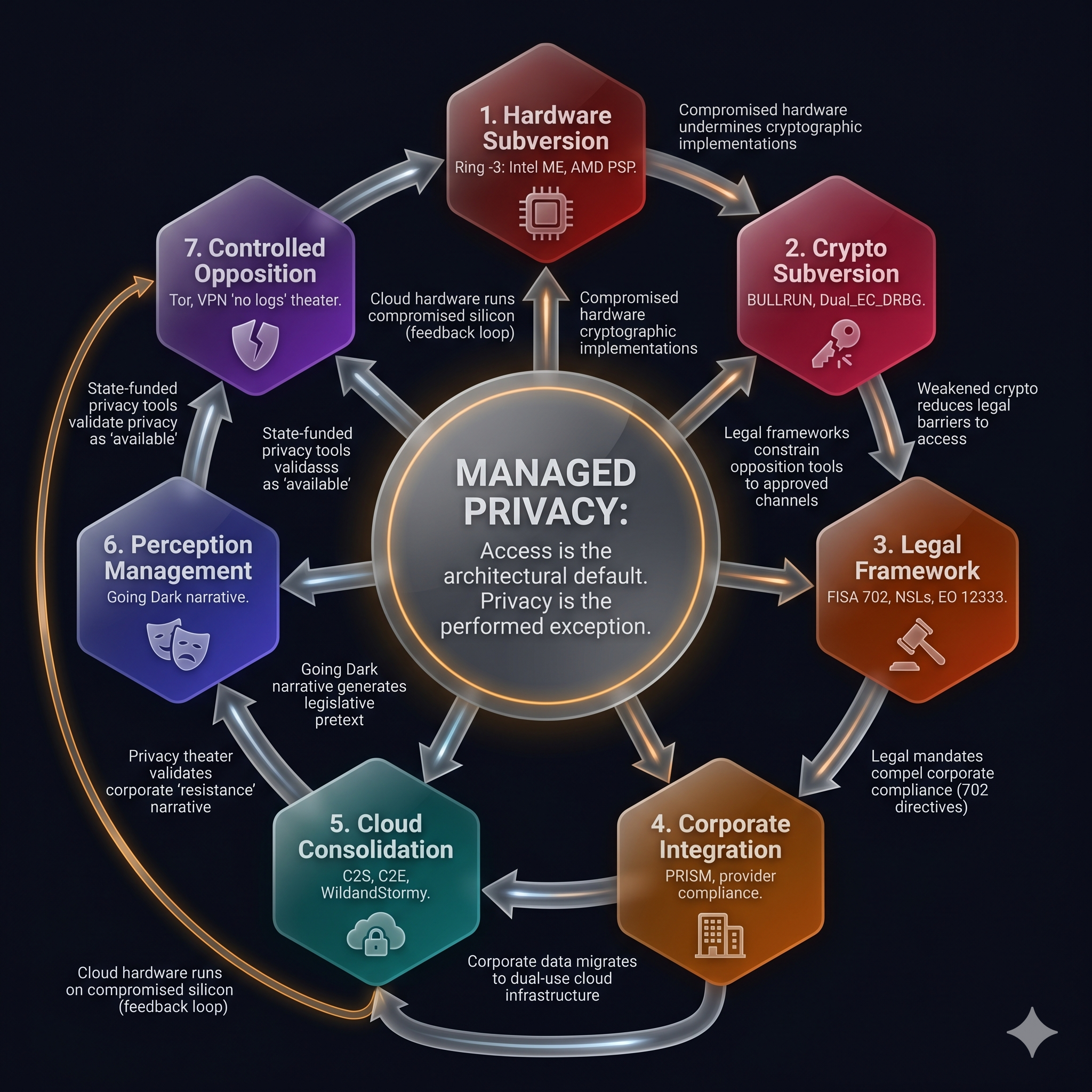
The contemporary digital architecture is frequently framed as a dialectic between individual privacy and national security. However, a rigorous analysis of historical signals intelligence (SIGINT) directives, hardware architecture, and state-corporate integration suggests this dichotomy is a manufactured illusion. This paper argues that privacy, in the Westphalian sense of sovereign exclusion, has been rendered structurally impossible, or more precisely, reduced to a managed privacy: an environment in which the appearance of protection is sufficiently convincing to sustain trust and data flows, while durable channels of institutional access remain intact.
Through analysis of the Clipper Chip, the BULLRUN program, the Dual_EC_DRBG standardization scandal, PRISM, cloud-intelligence contracting, and the silicon-level sovereignty of the Intel Management Engine, this report demonstrates that the internet was not merely compromised after the fact, but was designed, standardized, and legislated to ensure the state maintains permanent, "subcutaneous" access to the global nervous system of data. The result is not necessarily omniscient surveillance in practice, but an architecture optimized for access (technical, legal, and institutional access) paired with perception management that preserves the public's investment in the myth of contested encryption.
Beyond the Privacy and Security Dichotomy
The Illusion of the Binary
The prevailing discourse regarding digital privacy posits a tug-of-war between civil liberties and the operational imperatives of the intelligence community (IC). Civil liberties organizations warn of overreach; intelligence officials invoke the specter of "going dark." This report contends that such a framing is an epistemological error. It presupposes that privacy exists as a default condition occasionally intruded upon by state power. The historical and technical record suggests an inversion: the infrastructure of global digital communication was designed with state access as a foundational requirement, with privacy protections operating as negotiated exceptions rather than violated norms.
In this sense, the global internet functions less as a contested space than as a digital panopticon, a system of total visibility where the observer is obscured and the observed is permanently exposed. This reality is not the product of accidental vulnerabilities. It reflects a deliberate, multi-decade strategy of structural subversion: embedding access capabilities into the mathematical standards of encryption, the administrative law of compliance, the commercial incentives of the cloud economy, and the physical silicon of processors.
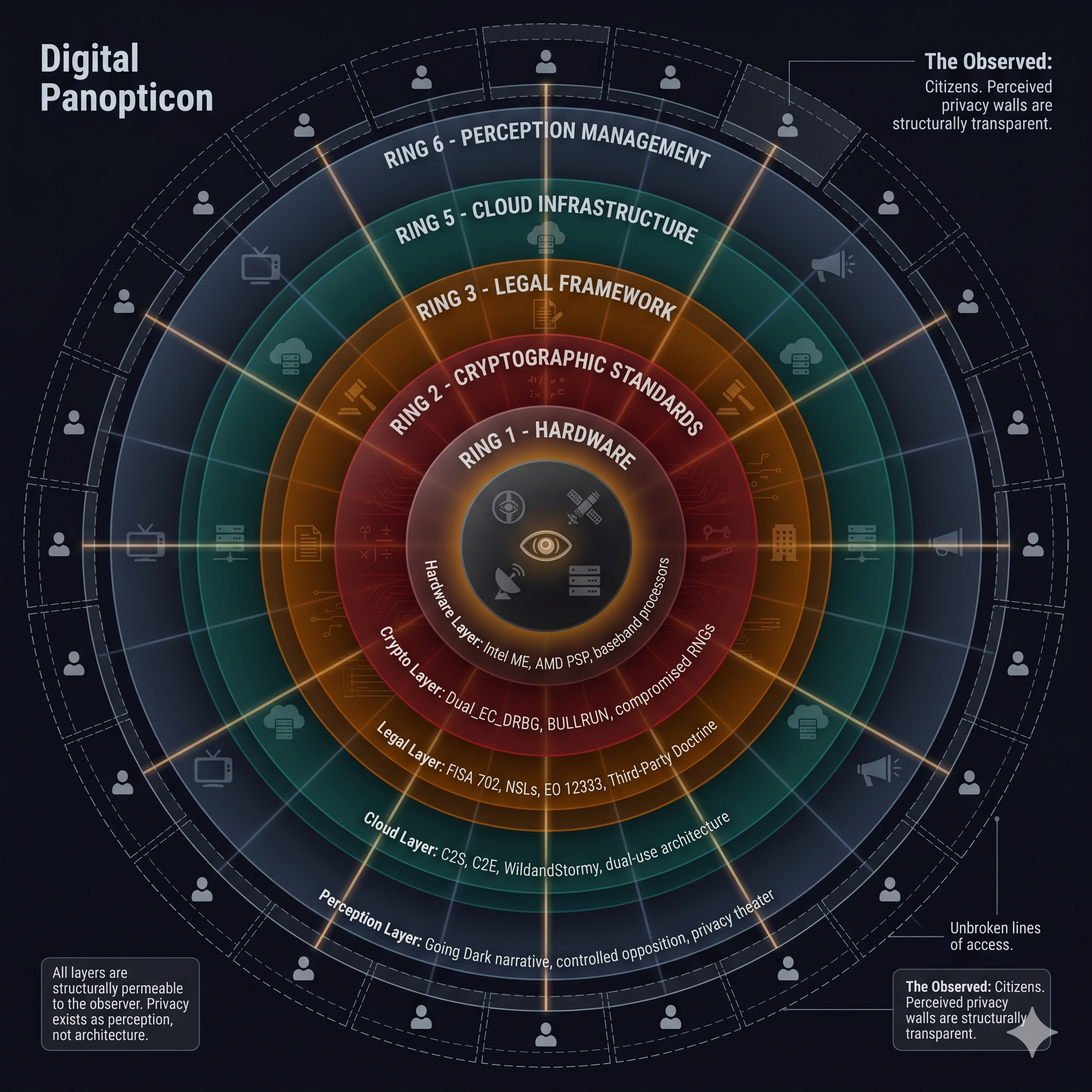
This claim is architectural rather than metaphysical. It does not require belief in omniscient surveillance, nor does it deny real technical obstacles, resource constraints, bureaucratic failures, or moments of genuine institutional conflict. Rather, it argues that the system is engineered for access even when access is imperfectly realized. Once that distinction is accepted, the policy problem changes: the locus of concern shifts from isolated "backdoors" to a surveillance ecosystem whose default settings (technical, legal, and institutional) normalize transparency to the state.
The architecture does not need to capture everything all the time. It only needs to make access routine, scalable, and legally normalized, while permitting enough "privacy" to sustain legitimacy and participation.
Hardware-Level Sovereignty
The Foundation of Persistent Access
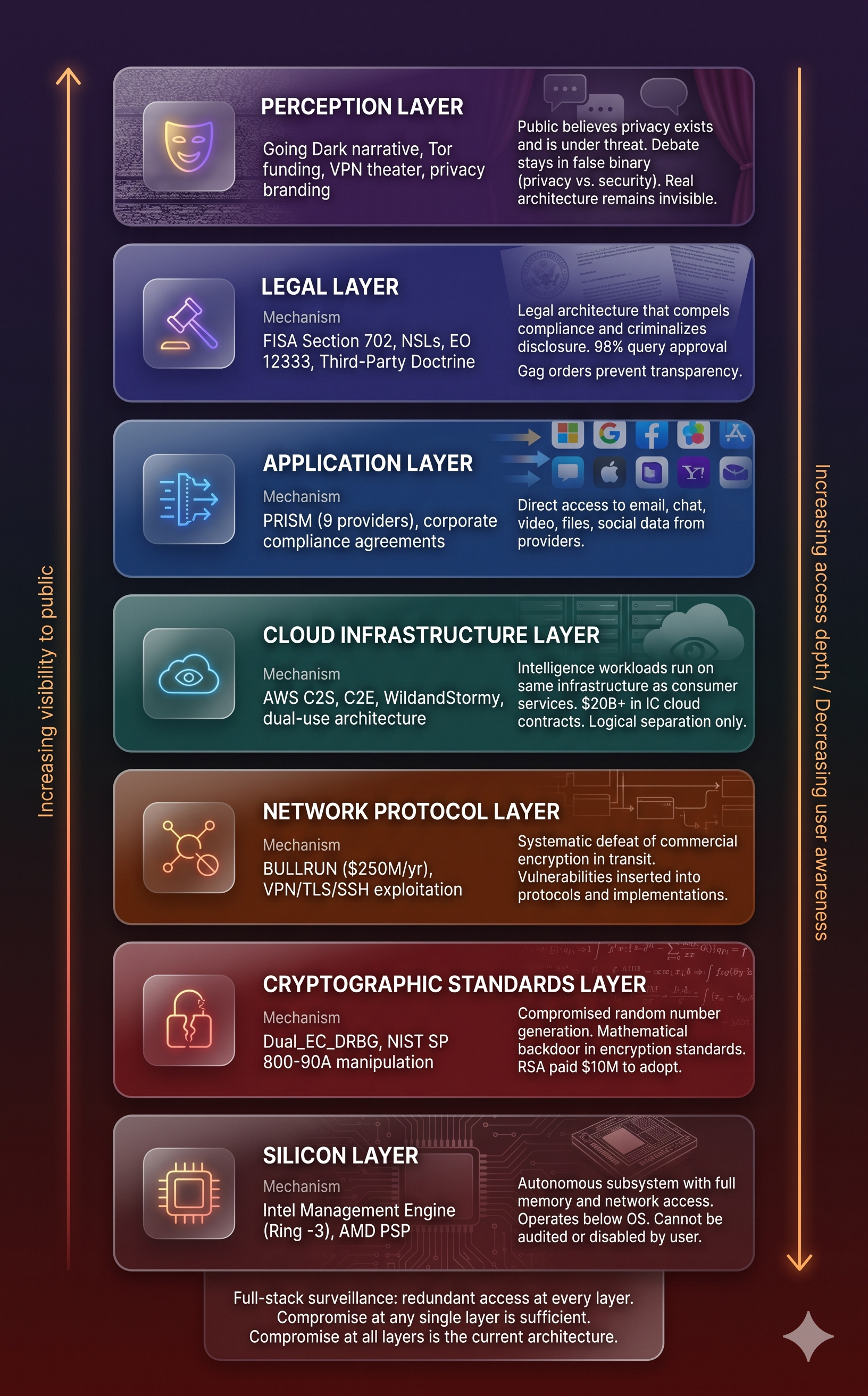
Public debate about surveillance tends to fixate on software encryption and app-level security. Yet the most consequential access mechanisms are often embedded at the hardware level, beneath the jurisdiction of user choice, operating system integrity, and even virtualization controls.
The Silicon Core: The Intel Management Engine (Ring -3)
Every Intel processor manufactured since 2008 contains the Intel Management Engine (ME), a subsystem frequently described as a "hidden operating system." Operating at "Ring -3," the ME sits below user space (Ring 3), the OS kernel (Ring 0), and the hypervisor (Ring -1), and is intertwined with System Management Mode (Ring -2). In practical terms, it has autonomous access to system memory, the network stack, and peripheral devices, functioning independently of the host operating system and remaining active whenever the motherboard receives power, even if the computer is "off" but plugged in.[16]
The ME is a black box. Its firmware is cryptographically signed, its internals are not auditable by users, and independent researchers have repeatedly documented vulnerabilities enabling high-privilege compromise. The most politically revealing evidence of its intended logic is the discovery of the "High-Assurance Platform" (HAP) mode in 2017: an undocumented configuration flag that disables substantial ME functionality. This mode was requested by the NSA for high-security systems.[16, 17] The implication is difficult to avoid: the intelligence community treats the ME as a security liability for its own machines while it remains structurally unavoidable for everyone else, suggesting a backdoor architected for the masses but deactivated for the masters.
The intelligence community disables the Intel ME on its own machines. Everyone else has no choice but to run it. A backdoor architected for the masses, deactivated for the masters.
This reality collapses many popular privacy assumptions. Software-based protections, including Tor, VPNs, and end-to-end encrypted messaging, operate atop hardware that may capture data as it is processed in memory. If the CPU itself is compromised, no amount of encryption can prevent capture at the endpoint.
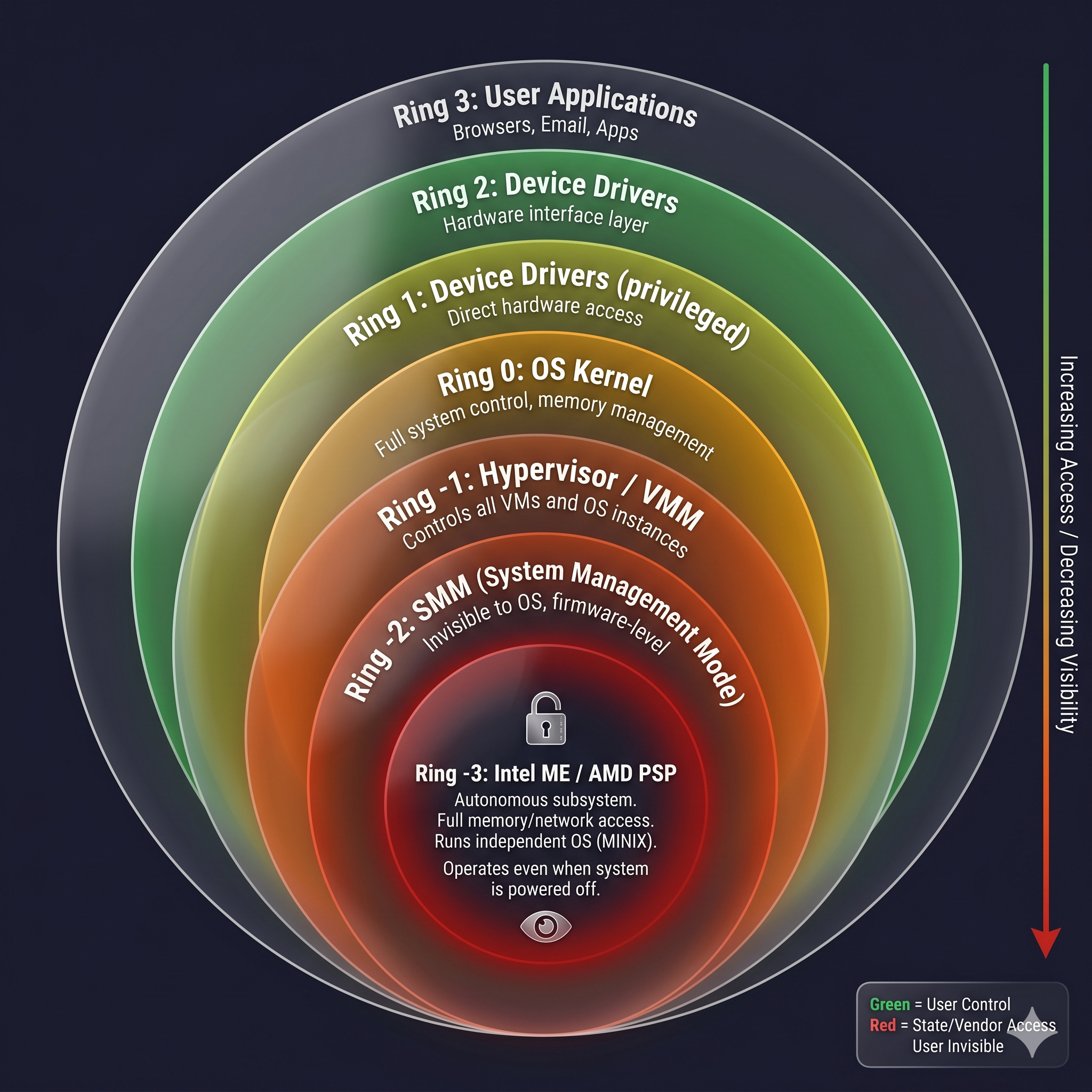
| Privilege Level | Entity | Access Control | Vulnerability to State Access |
|---|---|---|---|
| Ring 3 | User Space | Restricted to application-level data | Full visibility from all layers below |
| Ring 0 | OS Kernel | Direct hardware control for the OS | Subject to OS-level backdoors |
| Ring -1 | Hypervisor | Manages virtual machines | Compromised by firmware-level attacks |
| Ring -2 | SMM | System Management Mode | Hidden from the OS entirely |
| Ring -3 | Intel ME | Total, autonomous, persistent access | State-mandated hardware backdoor |
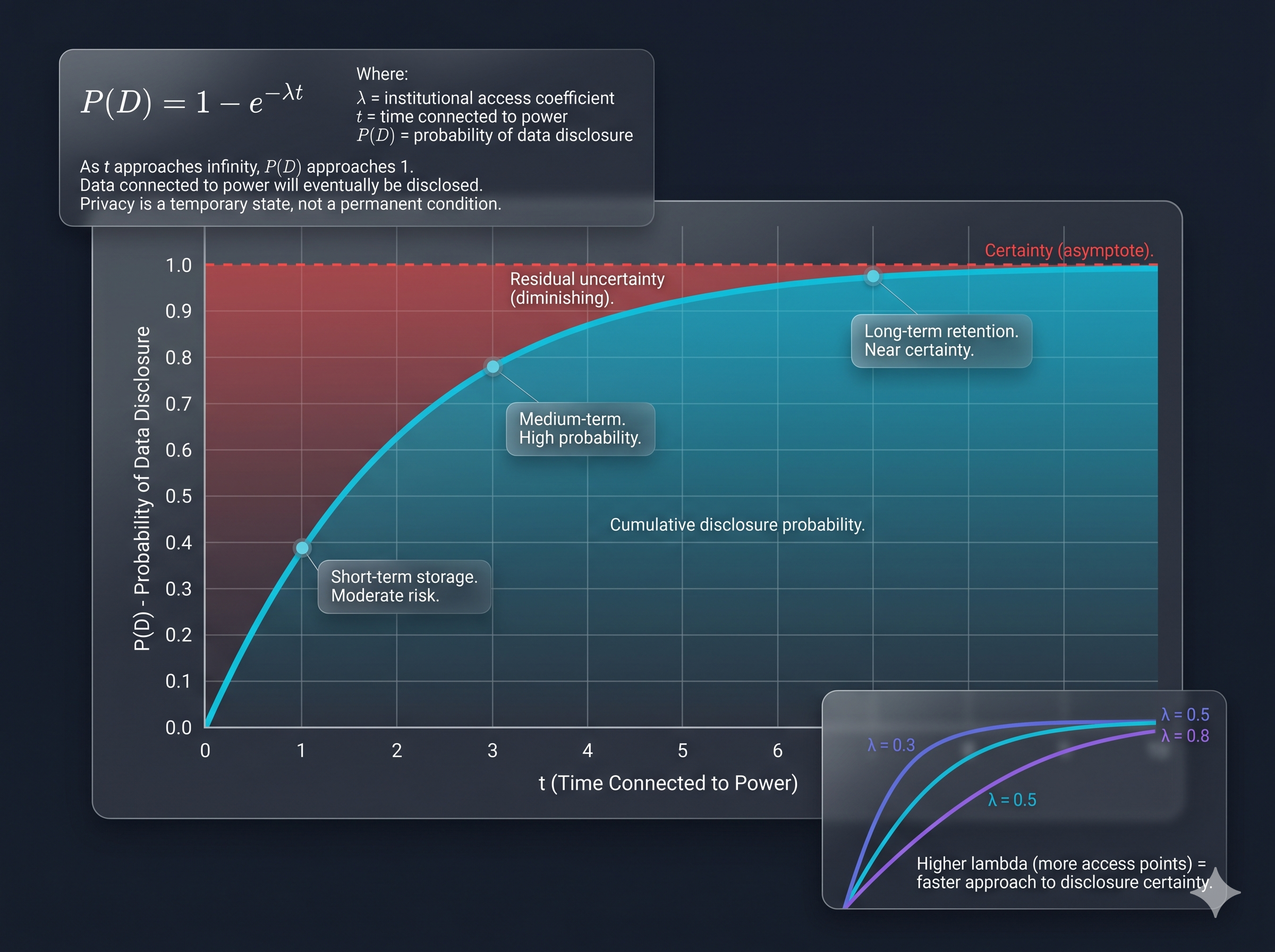
The analytical conclusion is blunt: privacy claims that do not confront hardware sovereignty are, at best, partial. At worst, they are theater performed on a stage already wired for recording.
The Archaeology of Cryptographic Subversion
From Overt Mandates to Algorithmic Corruption
State pursuit of cryptographic access is not a post-9/11 anomaly but a structural feature of modern SIGINT strategy. What changes over time is not the objective (access to protected communications) but the tactic: from overt mandates that risk political backlash, to covert subversion embedded in standards and supply chains.
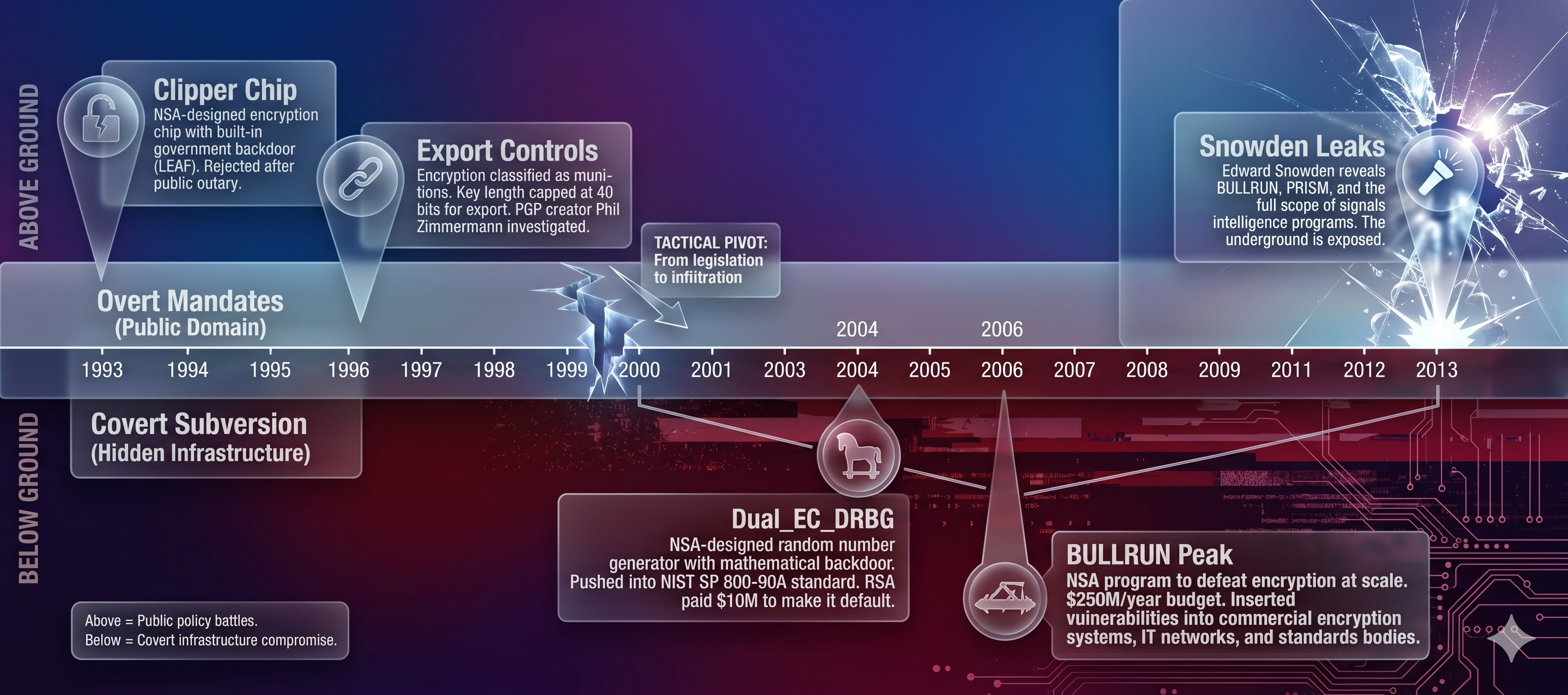
The Strategic Pivot: The Clipper Chip (1993 to 1996)
The initial attempts to institutionalize decryption access were overt. In 1993, the NSA introduced the Clipper Chip, a hardware-based encryption device for telecommunications that included a deliberate backdoor in the form of key escrow. Law enforcement and intelligence agencies would hold the necessary keys to decrypt communications upon demand.[1] Public backlash and technical vulnerabilities led to the program's official termination in 1996.
That termination is often narrated as a victory for privacy advocates. Structurally, it was more accurately a tactical pivot: the state learned that overt mandates are politically expensive, and that the same objective could be achieved more reliably through clandestine subversion of software and standards.
BULLRUN and the Corruption of Mathematics
The successor to Clipper was BULLRUN, a highly classified initiative revealed through the Snowden disclosures in 2013. BULLRUN operationalized cryptographic defeat through a multi-front strategy: computer network exploitation, industry relationships, implementation exploitation, and the intentional weakening of cryptographic standards.[1, 2] Unlike Clipper, BULLRUN was conducted in secrecy, ensuring that the foundations of "secure" communication were compromised at the source.
By 2006, the NSA reportedly had the capacity to defeat VPNs protecting foreign governments, airlines, and travel reservation systems, demonstrating that the "secure tunnels" used by the global elite were already transparent to the intelligence community.[2]
Dual_EC_DRBG: Standardizing a Backdoor
The subversion of standards reached its most documented form in the Dual_EC_DRBG algorithm. Designed by the NSA and standardized by NIST in 2006, Dual_EC_DRBG contained what cryptographers identified as a "rather obvious" kleptographic backdoor.[6] Random number generation is the keystone of encryption; if randomness is predictable to the designer, encryption becomes a performative ritual rather than a barrier.
The state's commitment to this subversion was financial and systemic. A secret $10 million deal reportedly paid to RSA Security ensured Dual_EC_DRBG became the default generator in the widely deployed BSAFE cryptography library. Even after concerns were voiced publicly in 2007, the algorithm remained a formal standard for seven years[6, 8], an instructive demonstration of how compromised systems can persist in plain sight through bureaucratic inertia and corporate compliance.
When the designer of randomness can predict the output, encryption is not a locked door. It is a door painted to look locked. The key was never missing; it was held by the painter.
| Year | Event / Program | Mechanism of Control | Strategic Outcome |
|---|---|---|---|
| 1993 | Clipper Chip | Hardware Key Escrow | Publicly exposed; triggered pivot toward clandestine subversion |
| 1996 | Export Controls | Regulation of Encryption Strength | Limited the global spread of strong cryptography |
| 2004 | Dual_EC_DRBG | Algorithmic Backdoor | Infiltrated NIST standards and commercial libraries (RSA BSAFE) |
| 2006 | BULLRUN (Peak) | Vulnerability Insertion | Stealth compromise of VPNs and TLS/SSL infrastructure |
| 2013 | Snowden Leaks | Disclosure of PRISM and BULLRUN | Revealed extent of state-corporate surveillance integration |
Perception Management: The Theater of "Going Dark"
Staged Conflict and the Performance of Contested Privacy
If structural access were merely technical, its political maintenance would be fragile. The durability of the surveillance architecture depends equally on perception management: staged conflict, carefully curated narratives, and the continuous performance that privacy remains robust and contested.
Juridical Theater: The Apple and FBI Dispute (2015 to 2016)
The legal dispute between the FBI and Apple over the encrypted iPhone 5C associated with the San Bernardino shooter is often described as a defining clash between privacy and security.[3] Yet when situated within the institutional logic of surveillance, it reads as juridical theater: a public struggle that manufactured legitimacy for both parties.
For months, the FBI argued that access was technically impossible without Apple creating a modified iOS to defeat security features. Yet as a precedent-setting hearing approached, implicating compelled speech and the All Writs Act, the FBI abruptly claimed it had found a third party capable of unlocking the device and withdrew the case.[3, 11] This conveniently avoided the risk of an unfavorable legal ruling while preserving the public belief that encryption is so formidable it requires rare, million-dollar hacks to defeat.
Security experts, including Edward Snowden, argued that NAND mirroring techniques capable of bypassing the ten-try limit were within elite capabilities.[9] Whether or not the FBI had that capacity in-house is, in some sense, less important than the institutional incentives the case served.
The "Going Dark" Narrative as Strategic Communication
The episode catalyzed the "Going Dark" narrative: the claim that law enforcement is becoming "blind" in the face of ubiquitous encryption.[12] By staging public impotence, the state achieved three political objectives:
- Validation: It bolstered the branding of major technology companies as defenders of privacy, encouraging user trust in devices and ecosystems already structurally integrated with state access.
- Narrative Construction: It reinforced the false dichotomy between absolute privacy and absolute security, priming the public to accept "compromises" that reliably favor state access.
- Legislative Pretext: It generated political capital for "Clipper 2.0" proposals, such as the EARN IT Act, which seek to mandate exceptional access under child protection rhetoric.[15]
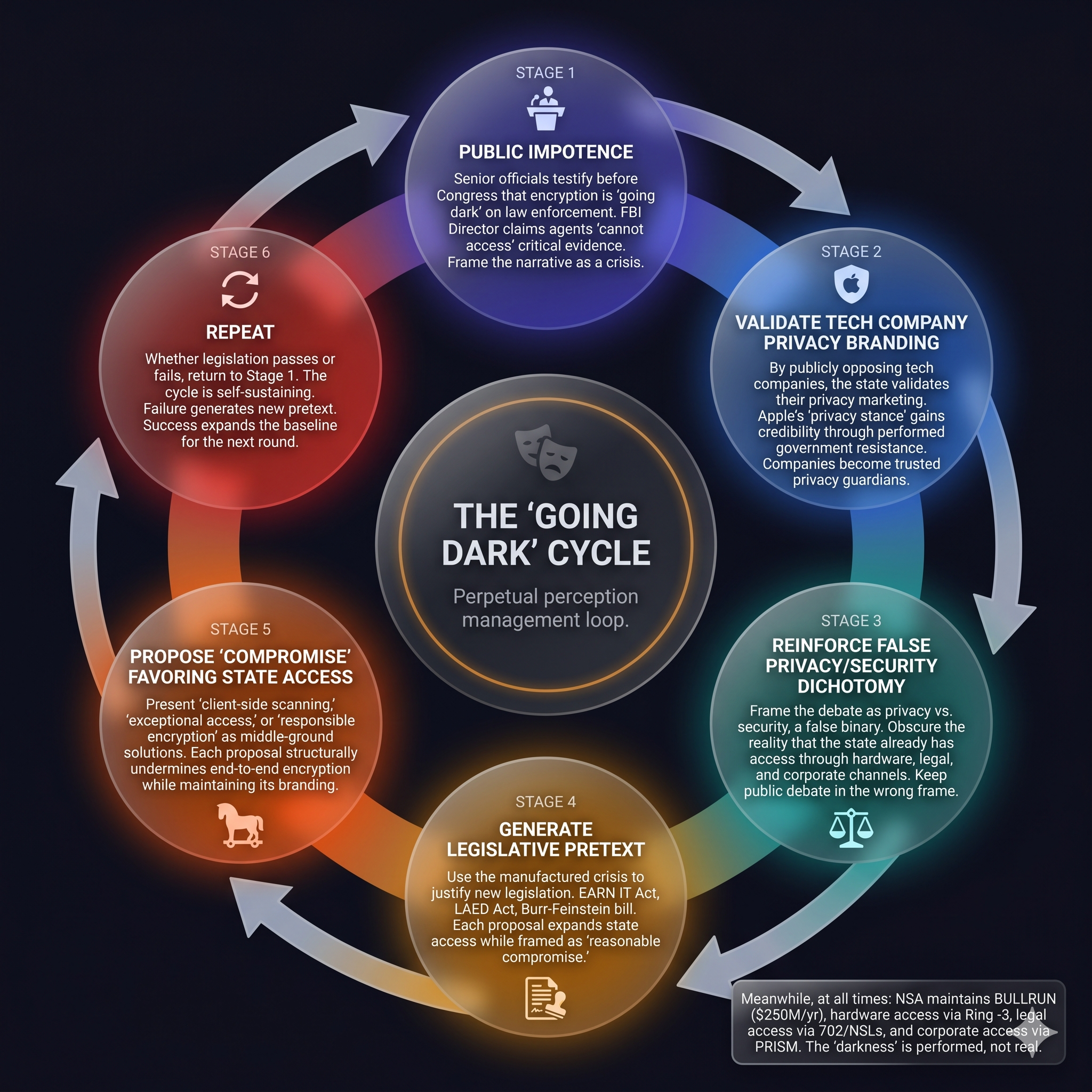
Importantly, this interpretation does not require conscious coordination between Apple and the FBI. Institutional incentives suffice: Apple benefits from being seen as resisting; the FBI benefits from being seen as blocked. Both outcomes stabilize the broader architecture by sustaining belief in the drama of contested encryption.
The most effective perception management does not require a conspiracy. It only requires that each institution act in its own interest within a system where those interests converge on the same structural outcome: the sustained illusion that encryption is genuinely contested.
The PRISM Consortium: Silicon Valley as an Intelligence Arm
When "Private" Companies Become Compliance Infrastructure
The perception that major technology companies are the guardians of user privacy is contradicted by the operational reality disclosed through PRISM. Leaked documents verify that the NSA obtained access to data from Microsoft, Yahoo, Google, Facebook, PalTalk, YouTube, Skype, AOL, and Apple, covering email, stored data, chats, file transfers, and social networking details.[7]
Companies denied "direct access," but the dispute is partly semantic. Under Section 702 of FISA, providers can be compelled to facilitate data extraction. PRISM materials describe the FBI's Data Intercept Technology Unit (DITU) functioning as an intermediary, delivering selectors to providers, who then comply through dedicated compliance channels.[7, 18, 19] Some firms reportedly built "separate, secure portals" or digital equivalents of secure physical rooms to facilitate collection.
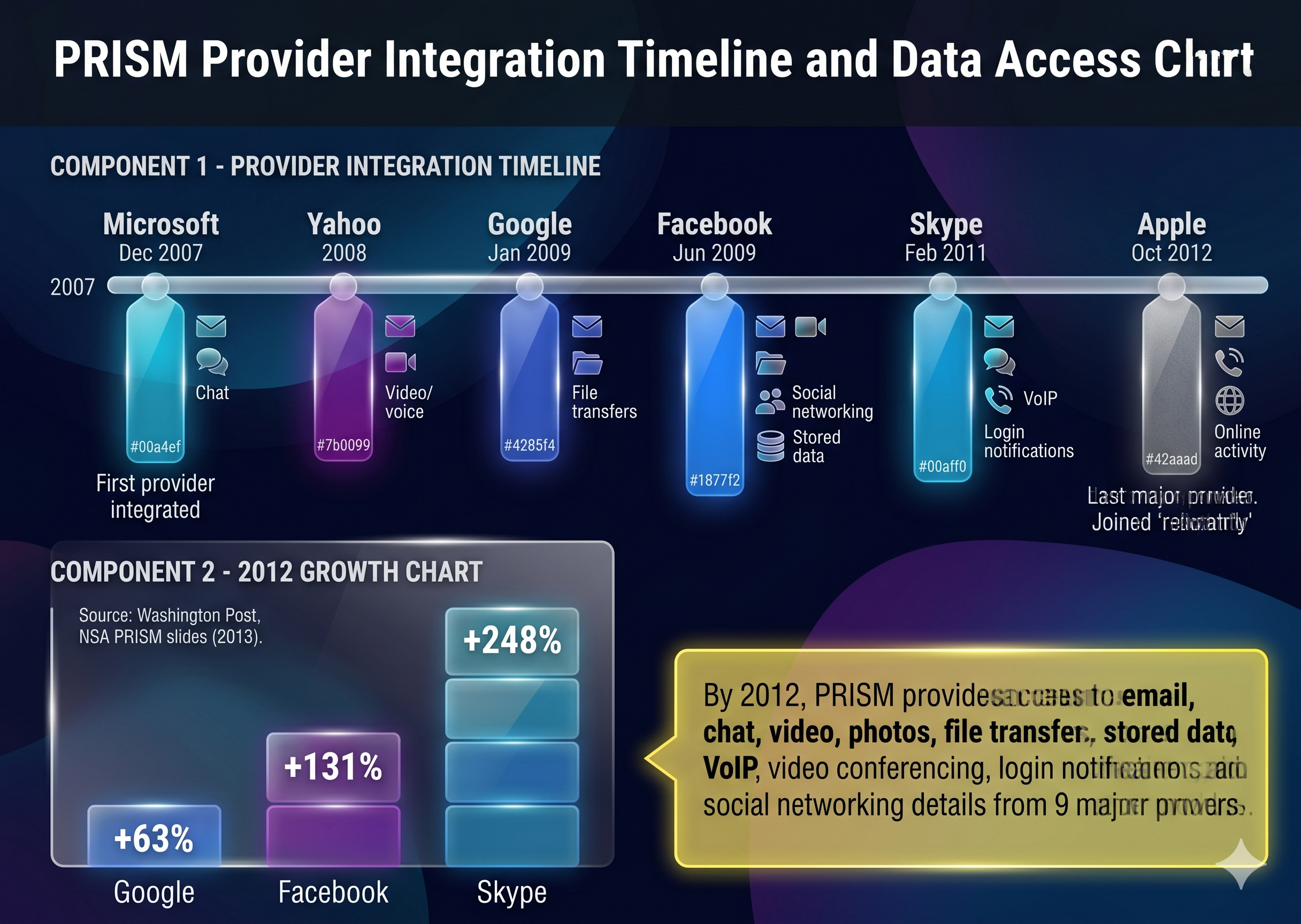
| Provider | Joined PRISM | Data Access Scope | Growth in Requests (2012) |
|---|---|---|---|
| Microsoft | Dec 2007 | Email, Chats, Stored Data | - |
| Yahoo | 2008 | Email, Metadata | - |
| 2009 | Search, Gmail, YouTube | +63% | |
| 2009 | Social Network, Chats | +131% | |
| Skype | 2011 | VoIP, Real-time Audio and Video | +248% |
| Apple | 2012 | iCloud, Device Backups | - |
PRISM accounts for over 91 percent of all internet communications acquired under Section 702,[7] illustrating that Silicon Valley is not structurally external to the state but integrated into the operational supply chain of surveillance.
The legal framework does more than authorize access. It stabilizes compliance. The FISA Amendments Act provides indemnification and liability shielding for cooperating firms. Meanwhile, incidental collection ensures that domestic communications are swept into systems nominally justified as foreign intelligence.
When 91% of internet communications collected under Section 702 flow through PRISM, "partnership" is an understatement. Silicon Valley is not adjacent to the intelligence community. It is load-bearing infrastructure.
Cloud Consolidation and the End of the "Private" Data Center
When Your Infrastructure Is Their Infrastructure
If PRISM represents targeted extraction, cloud consolidation represents architectural centralization. The migration of state, corporate, and personal data into a handful of platforms, including AWS, Microsoft, and Google, turns the cloud into a centralized intelligence surface.
The CIA's $600 million C2S contract with AWS in 2013 was not merely a procurement decision. It was a blueprint for infrastructural merger.[51, 54] Subsequent multi-billion C2E contracts expanded cloud services across the intelligence community. Most strikingly, the NSA's "WildandStormy" contract with AWS reflects the modernization of signals intelligence itself through commercial cloud infrastructure.[52, 54]
The implication is not simply that the intelligence community is using the cloud. It is that the intelligence community helped define the cloud's security architecture. If the NSA trusts AWS with its most sensitive workloads, it is because the infrastructure meets intelligence requirements, requirements that coexist with commercial tenancy.
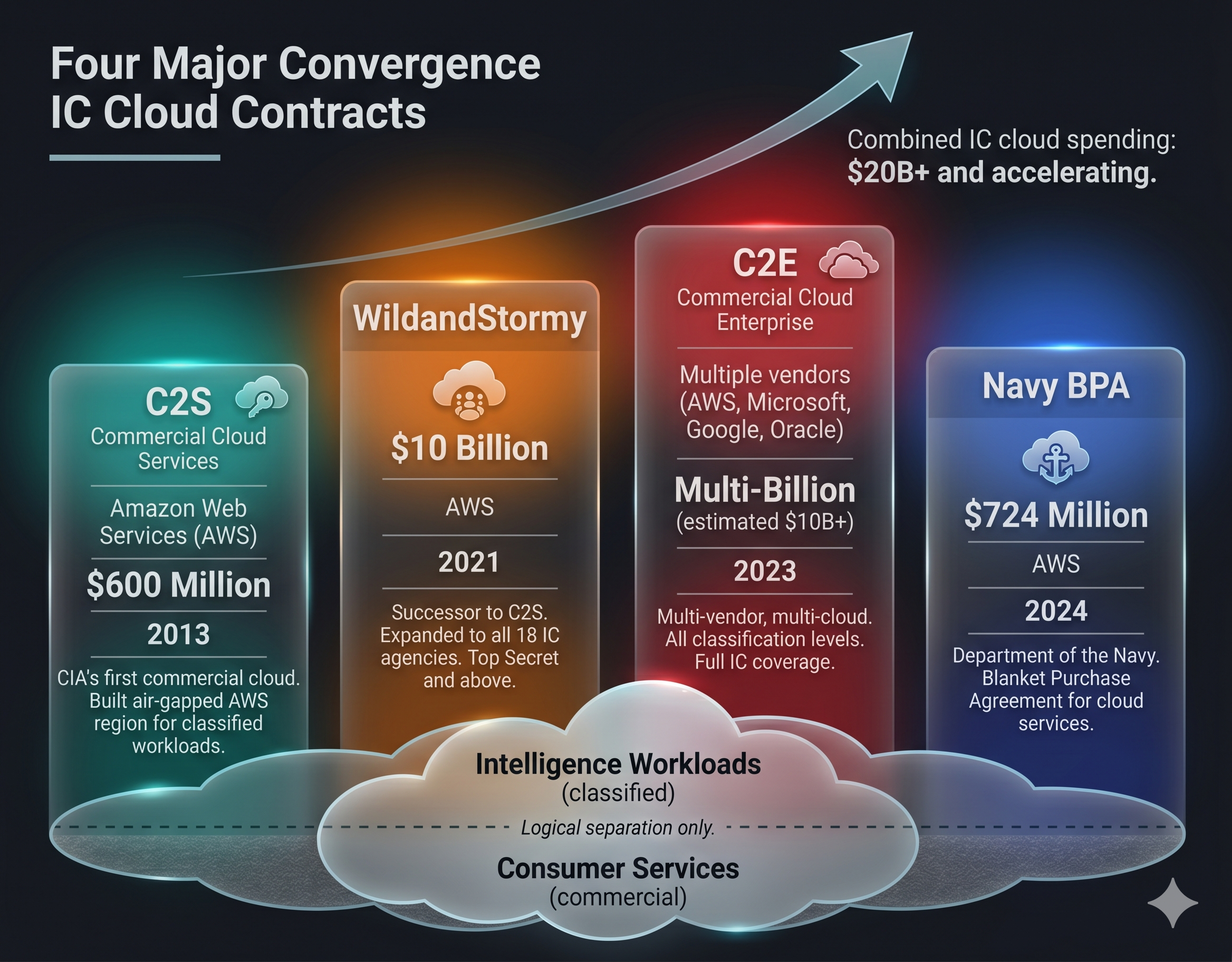
| Provider | Contract Name | Value | Duration | Scope |
|---|---|---|---|---|
| AWS | C2S | $600 Million | 2013-2023 | Initial IC migration to cloud |
| AWS | WildandStormy | $10 Billion | 10 Years | NSA signals intelligence modernization |
| AWS / Google / Microsoft | C2E | Multi-Billion | 15 Years | Multi-cloud for 17 IC agencies |
| AWS | Navy License BPA | $724 Million | 5 Years | AWS GovCloud access for U.S. Navy |
In this model, privacy becomes administrative permission rather than physical separation: the "private" data center is replaced by shared infrastructure where access depends on legal authorities, provider compliance, and opaque security engineering.
Controlled Dissidence: The Paradox of Tor and the VPN Industry
When the Escape Route Is Part of the Map
A mature surveillance ecosystem does not merely suppress resistance. It often funds, shapes, and steers it. Tools marketed as escape routes can also function as containment channels, honeypots, or perception stabilizers.
The Tor Paradox: State-Sponsored Anonymity as Strategic Cover
Tor is routinely portrayed as the citizen's sanctuary from state surveillance. Its origins, however, reflect state strategy. Onion routing was developed at the U.S. Naval Research Laboratory with funding from the Office of Naval Research and DARPA.[23, 24] Its original purpose was to protect U.S. intelligence communications and enable covert online activity without revealing analyst location.
Tor's public release followed the logic of "cover traffic." For intelligence officers to use the network without suspicion, they required a crowd of ordinary users. As researchers noted, "anonymity loves company."[24] By funding and promoting Tor through aligned institutions, including the State Department and affiliated grant mechanisms, the U.S. government effectively cultivated a global anonymity infrastructure that helps provide concealment for its own operations.
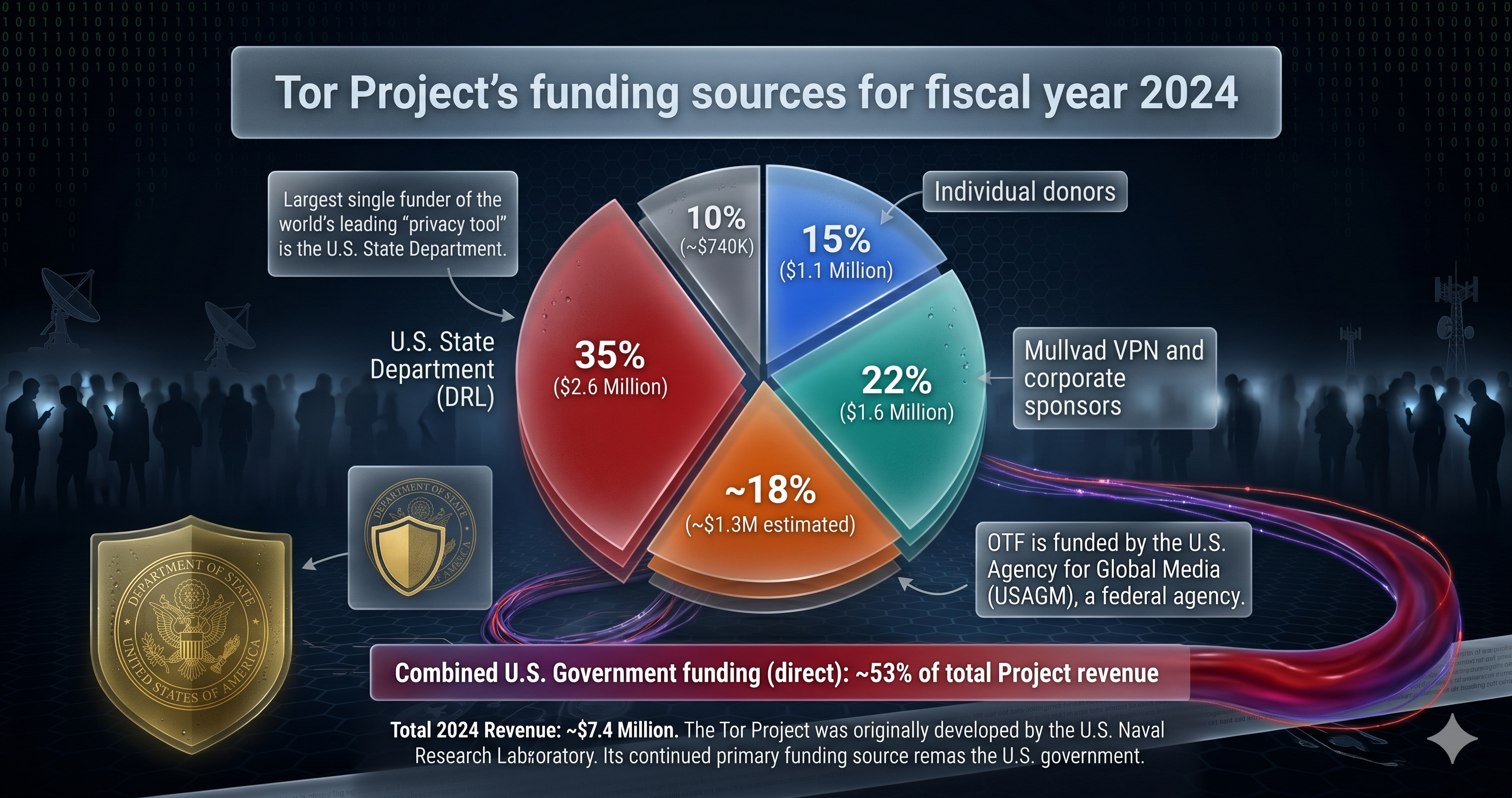
| Funding Source | Contribution (approx.) | Role in Surveillance Ecosystem |
|---|---|---|
| U.S. State Dept (DRL) | $2.6 Million (35%) | Promotes "Internet Freedom" as a tool for regime change |
| Open Technology Fund (OTF) | Indirect Grants | Funds tools that provide cover for military communications |
| Mullvad and corporations | $1.6 Million (22%) | Provides a veneer of corporate independence |
| Individual Donors | $1.1 Million (15%) | Minimal impact on core strategic direction |
Operationally, Tor is vulnerable to relay manipulation and timing correlation attacks. Any actor, including intelligence agencies, can run relays. If a state-level adversary controls sufficient entry and exit capacity, correlation can defeat anonymity with statistical confidence.[31, 32] In this context, Tor may function simultaneously as a privacy tool and as a high-value identification layer: it flags "interesting" users for deeper scrutiny.
The VPN Industry: Commercializing the Illusion of Security
If Tor represents state-adjacent anonymity, consumer VPNs represent commercialized security theater. Users are encouraged to believe that paying for a "secure tunnel" produces anonymity. In practice, a VPN often merely substitutes the observer: it moves visibility from the ISP to the VPN provider, an entity embedded in legal jurisdictions and financial pressures that frequently align with state access.
"No-logs" marketing claims have repeatedly collapsed under court orders and enforcement disclosures. The consolidation of VPN providers under Kape Technologies (formerly Crossrider) illustrates the structural risk: Kape, an Israeli-linked company with ties to Unit 8200 circles and roots in adware distribution, owns several prominent VPN brands.[39, 40, 41] When "privacy" infrastructure is owned by intelligence-adjacent capital, the service should be evaluated as part of the surveillance economy, not outside it.
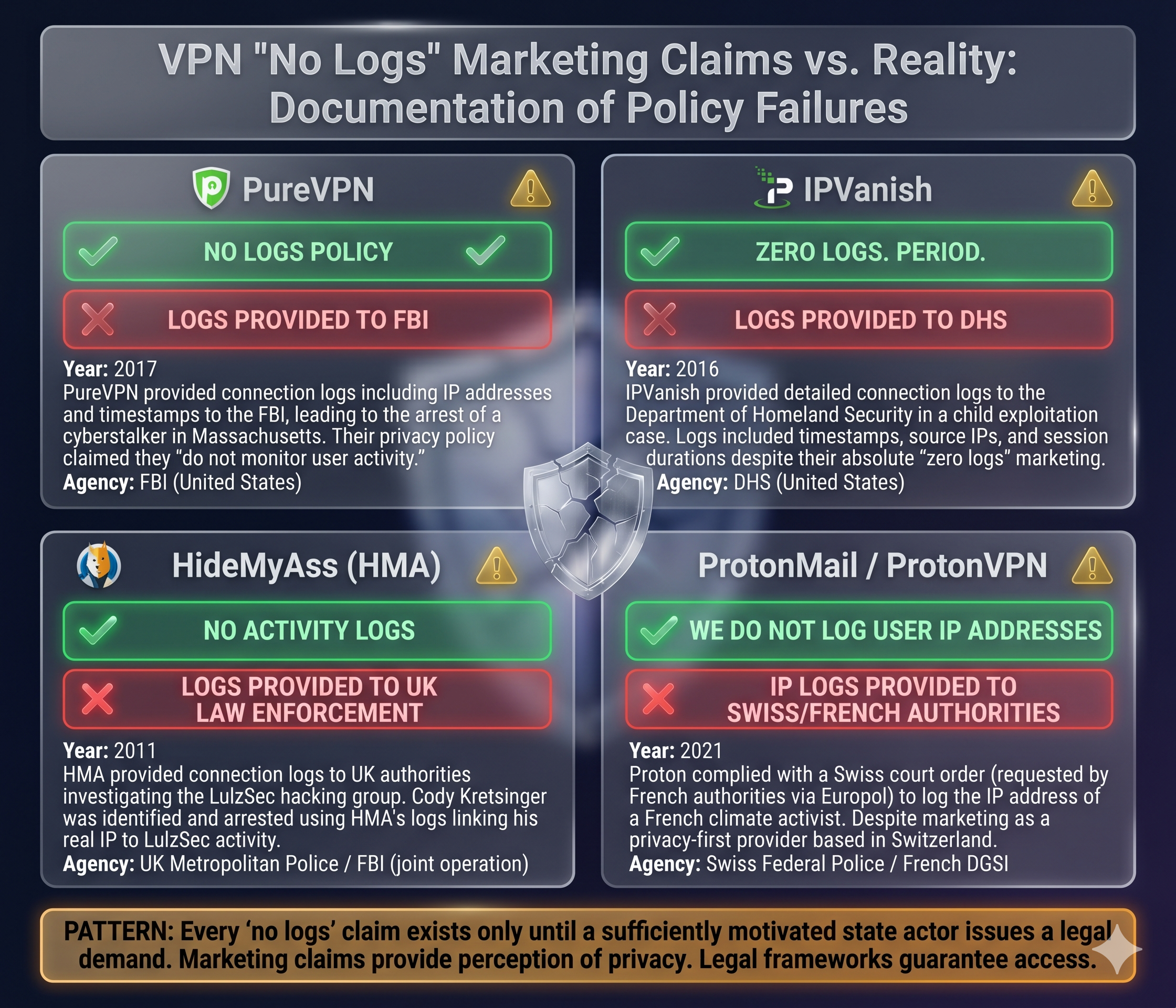
| Provider | Stated Privacy Policy | Enforcement Action / Disclosure |
|---|---|---|
| PureVPN | "Zero Logs" | Provided IP logs to FBI in 2017 to catch a cyberstalker |
| IPVanish | "Zero Logs" | Handed over detailed connection logs to DHS in 2016 |
| HideMyAss | "Anonymity Service" | Provided connection logs to UK authorities for LulzSec arrest |
| ProtonMail | "No IP Logging" | Logged and provided IP address to Swiss and French authorities in 2021 |
Technically, advanced techniques, including deep packet inspection, metadata analysis, and traffic fingerprinting, allow detection and profiling even when payloads are encrypted.[48] Politically, VPNs can generate risk compensation: users behave more recklessly because they believe the tunnel makes them invincible. Structurally, VPNs centralize traffic into identifiable aggregation points that simplify targeted collection.
Legislative Architecture: Codifying Access and Enforcing Silence
Law as Infrastructure
The state does not rely solely on technical subversion. It codifies access through law while limiting public oversight through secrecy mechanisms.
Section 702 and Programmatic Collection
Section 702 authorizes programmatic surveillance targeting non-U.S. persons abroad, but the architecture of global routing ensures vast incidental collection of U.S. person communications.[21] Renewals and expansions normalize the model: surveillance becomes routine infrastructure rather than emergency exception. FBI query practices, searching databases containing incidentally collected U.S. person communications, further blur the boundary between foreign intelligence and domestic surveillance.[60]
National Security Letters and Gag Orders
National Security Letters allow the FBI to compel disclosure of data without judicial oversight, often accompanied by gag orders preventing providers from acknowledging the request.[57, 58] This creates a parallel legal system: administrative subpoenas that operate in darkness, where disclosure of the mechanism itself becomes legally risky.
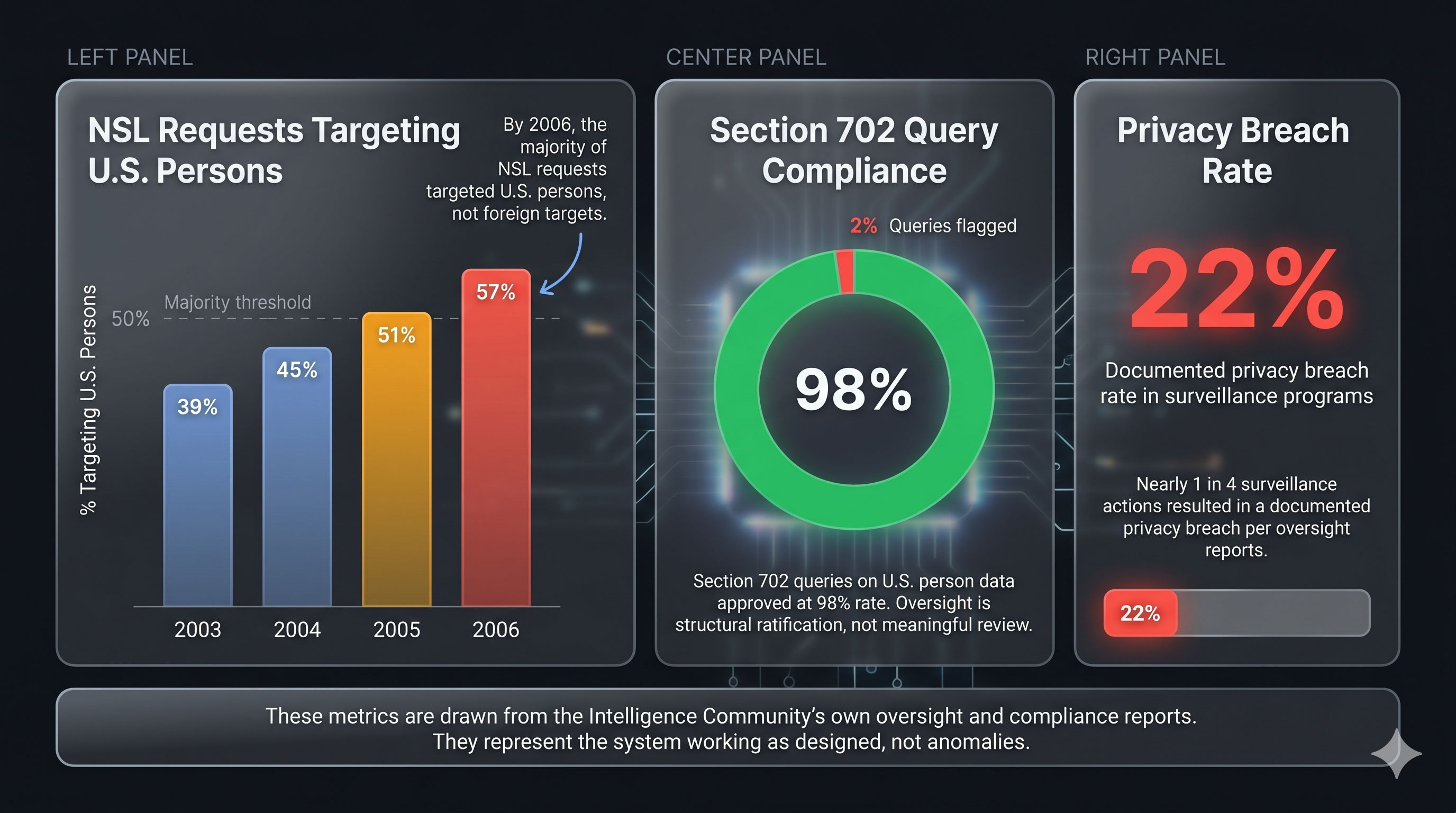
| Statistic | Value / Trend | Significance |
|---|---|---|
| FBI NSL "Privacy Breaches" | 22% of cases examined | High rate of abuse in warrantless searches |
| Section 702 Query Standard | 98% Compliance (per FBI) | Indicates deep, routine searching of "incidentally" collected data |
| NSL Requests on U.S. Persons | 39% (2003) to 57% (2006) | Significant increase in targeting of domestic actors |
| Bulk Collection Status | Precluded by USA FREEDOM Act | Pivot toward targeted, but programmatic, mass-extraction |
The Legislative Enclosure: "Clipper 2.0"
Legislation such as the EARN IT Act and the Lawful Access to Encrypted Data Act seeks to formalize exceptional access, effectively mandating that unbreakable encryption cannot exist for the general public.[15] This is the endgame of the "Going Dark" narrative: to present total access as reluctant necessity rather than longstanding objective.
The legislative strategy does not need to ban encryption outright. It only needs to make "compliant" encryption the default and frame non-compliant encryption as evidence of wrongdoing. The effect is the same; the optics are better.
Limitations and Counterarguments
What This Analysis Does Not Claim
Scholarly integrity requires acknowledging the boundaries of this analysis, especially given the temptation, in surveillance discourse, to slide from structural critique into omniscience claims.
1. Privacy protections can be real. GDPR has constrained corporate practices. Apple's Lockdown Mode is meaningful hardening. Signal's audited architecture has proven resilient. Properly implemented end-to-end encryption imposes genuine costs and can deny content even when metadata remains exposed.
2. Resource constraints matter. Mass collection is not identical to mass analysis. Intelligence agencies face finite analytical capacity; most individuals remain practically obscure despite theoretical visibility.
3. Legal constraints are imperfect but not irrelevant. FISC rulings, inspector general reports, and congressional oversight have sometimes curtailed programs or documented abuses. The constraints often arrive late and incompletely, but they exist.
4. The argument is structural, not totalizing. This paper argues the system is designed for access, not that access is always achieved, or that privacy tools are futile in every context.
These counterpoints do not dissolve the thesis; they sharpen it. The most durable surveillance architecture is not one that captures everything all the time, but one that makes access routine, scalable, and legally normalized, while permitting enough "privacy" to sustain legitimacy and participation.
Managed Privacy in the Glass House
Conclusion
The evidence presented supports a revision of contemporary privacy discourse. Digital privacy is neither a robust default occasionally violated nor a complete fiction. It is better understood as managed privacy: a system that provides sufficient appearance of protection to maintain user trust and data flows, while preserving institutional channels of access.
This management operates through multiple, reinforcing mechanisms:
- Hardware architectures opaque to users and privileged beyond software control (Ring -3).
- Cryptographic standards shaped by intelligence interests (Dual_EC_DRBG) and exploitation programs (BULLRUN).
- Legal authorities enabling programmatic collection and warrantless extraction (Section 702, National Security Letters).
- Corporate integration where "private" firms function as compliance infrastructure (PRISM).
- Cloud consolidation that centralizes global data on platforms that are also intelligence partners (C2S, C2E, WildandStormy).
- Perception management that sustains the theater of contested encryption (Apple and FBI, "Going Dark").
- Controlled opposition and commercial security theater that channels dissent into surveillable ecosystems (Tor funding dynamics; VPN "no-logs" collapses).
In this environment, the only stable privacy is not a feature but a refusal: silence, minimization, and structural redesign. Yet even that refusal is increasingly modeled, inferred, and profiled by AI-driven analytics.
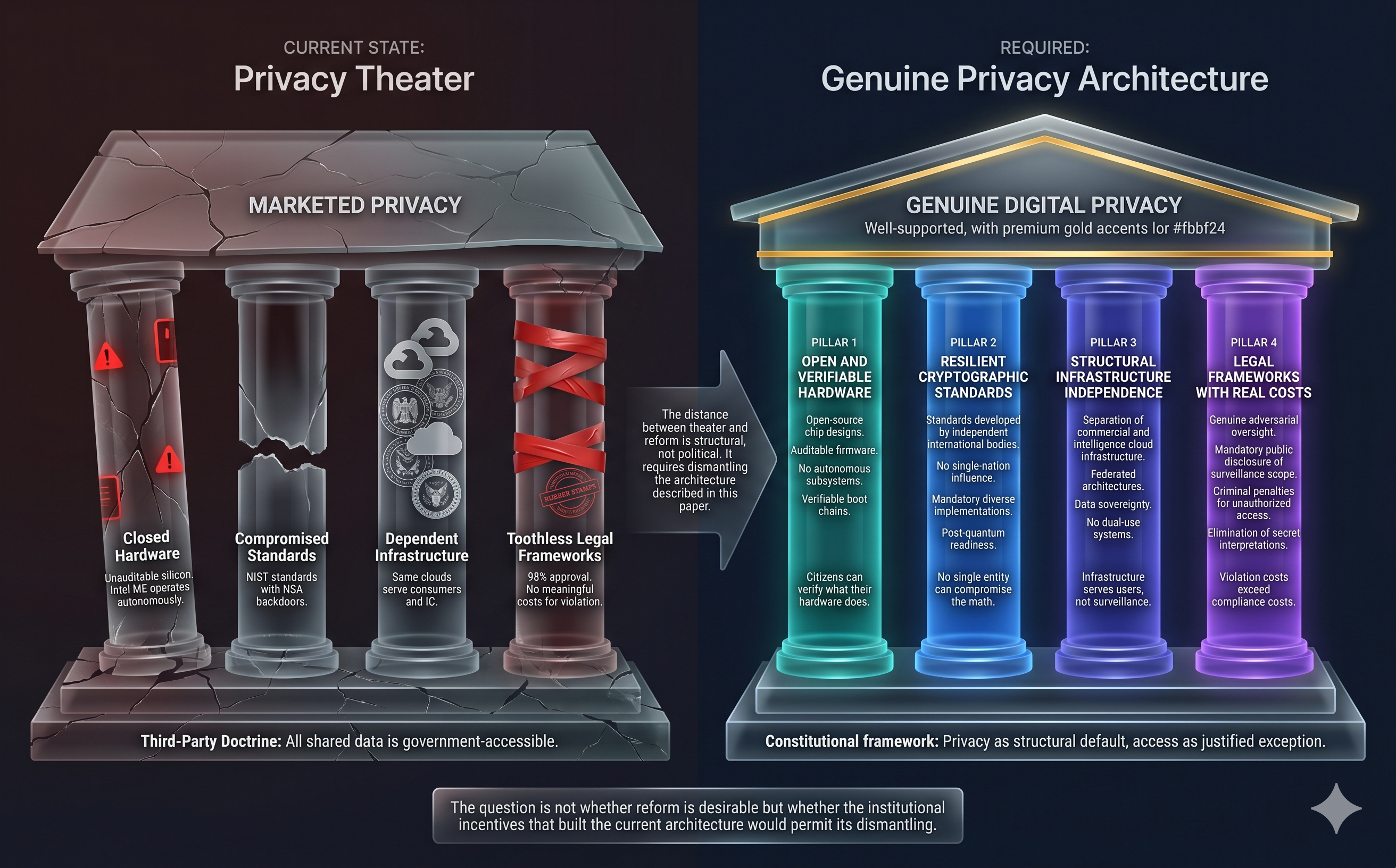
What Meaningful Reform Would Require
Reform efforts focused solely on individual backdoors, individual statutes, or individual corporate commitments will remain inadequate if the underlying architecture is unchanged. Meaningful privacy would require:
- Open and verifiable hardware whose firmware can be independently audited and whose subsystems do not operate beyond user control.
- Resilient cryptographic standard-setting insulated from intelligence capture, with transparent processes and adversarial review.
- Structural independence of communications infrastructure from intelligence-adjacent capital and contracting relationships.
- Legal frameworks that impose real costs, not merely procedural friction, on institutional access to personal data.
Whether such reforms are politically achievable remains uncertain. What is no longer tenable is the premise that privacy is the natural condition of digital life and surveillance a periodic rupture. The historical record and the technical stack indicate the opposite: access is the baseline, privacy the carve-out, granted conditionally and withdrawn quietly.
In that world, "backdoors" are the wrong metaphor. A backdoor implies a sealed house and an illicit entry. The contemporary system is not sealed. It is architected for observability, normalized through law, operationalized through corporate integration, and defended by the public theater of "privacy features." We are not living in a fortress under siege. We are living in an instrumented environment. The question is no longer how to lock the door, but whether we are willing to rebuild the house.
References
- [1] A brief history of U.S. encryption policy, Brookings Institution. brookings.edu
- [2] Bullrun (decryption program), Wikipedia. wikipedia.org
- [3] Apple-FBI encryption dispute, Wikipedia. wikipedia.org
- [4] The Crypto Wars: Governments Working to Undermine Encryption, EFF. eff.org
- [5] The USA's loudest endorsement ever: CISA urges everyone to use encryption!, Tuta. tuta.com
- [6] Dual_EC_DRBG, Wikipedia. wikipedia.org
- [7] NSA Prism program taps in to user data of Apple, Google and others, The Guardian. theguardian.com
- [8] NIST drops controversial encryption algorithm, FedScoop. fedscoop.com
- [9] The False Choice at the Core of the Apple-FBI Standoff, RAND. rand.org
- [10] Customer Letter, Apple. apple.com
- [11] Court Decision: The FBI, Apple and the Company that Broke iPhone Encryption, Abrams Law. abramslaw.com
- [12] Counterterrorism, counterintelligence, and the challenges of "going dark" hearing, Senate Select Committee on Intelligence. intelligence.senate.gov
- [13] Encryption Friction, Government Law Review. albanygovernmentlawreview.org
- [14] Security vs. Privacy, Schneier on Security. schneier.com
- [15] The Unconstitutional, Unworkable EARN IT Act, TechFreedom. techfreedom.org
- [16] Intel Management Engine, Wikipedia. wikipedia.org
- [17] The Intel Backdoor Nobody Can Remove (Not Even You), YouTube. youtube.com
- [18] EPIC v. DOJ, PRISM, EPIC. epic.org
- [19] PRISM, Wikipedia. wikipedia.org
- [20] PRISM: A Closer Look at Tech's Newest Controversy, Mindgruve. mindgruve.com
- [21] FISA Section 702 and the 2024 Reforming Intelligence and Securing America Act, Congress.gov CRS. congress.gov
- [22] Was TOR created by the US govt.?, Reddit. reddit.com
- [23] Tor (network), Wikipedia. wikipedia.org
- [24] The Secret History of Tor, MIT Press Reader. mitpress.mit.edu
- [25] History, Tor Project. torproject.org
- [26] Supporters, Tor Project. torproject.org
- [27] The Tor Project, Wikipedia. wikipedia.org
- [28] Open Technology Fund, Hinchilla. hinchilla.com
- [29] Is it just me, or is Tor conspiring with a vulnerability?!, Reddit. reddit.com
- [30] Genuine question: TOR is a honeypot?, Reddit. reddit.com
- [31] Tor Routers, Schneier on Security. schneier.com
- [32] How the NSA Attacks Tor or Firefox Users With QUANTUM and FOXACID, Schneier on Security. schneier.com
- [33] The Pros and Cons of Using Tor, Camden Civil Rights Project. camdencivilrightsproject.com
- [34] Anonymity and the Tor Network, Schneier on Security. schneier.com
- [35] Investigating Security Folklore: A Case Study on the Tor over VPN, UCI. uci.edu
- [36] Can a Free VPN Service Be Trusted?, FineVPN. finevpn.org
- [37] The Best VPNs for Developers, SitePoint. sitepoint.com
- [38] Bitcoin fixes the VPN problem, CoinGeek. coingeek.com
- [39] Kape Technologies Now Owns ExpressVPN, CyberGhost, Private Internet Access, ZenMate, CyberInsider. cyberinsider.com
- [40] When VPNs turn into traps: Unit 8200 and the hidden dangers of corporate VPNs, Medium. medium.com
- [41] What is Kape Technologies?, Windscribe. windscribe.com
- [42] Strange Ties: Private Internet Access, Kape, and Crossrider, CyberInsider. cyberinsider.com
- [43] Trust, but verify, ZDNet. zdnet.com
- [44] The OPSEC Podcast, Acast. acast.com
- [45] The Safest VPN Apps, Protectstar. protectstar.com
- [46] "No Logs" IPVanish Hands Over Logs to Homeland Security, ProPrivacy. proprivacy.com
- [47] ProtonMail Gives Up Logs on User, CyberInsider. cyberinsider.com
- [48] VPN Traffic Analysis: A Survey, IEEE Xplore. ieeexplore.ieee.org
- [49] Security of VPNs in High-Surveillance Environments, ResearchGate. researchgate.net
- [50] What is a security feature that is really security theater?, Reddit. reddit.com
- [51] A decade-old risk led to "phenomenal partnership" between AWS and the intel community, Nextgov. nextgov.com
- [52] NSA Awards Secret $10 Billion Contract to Amazon, Nextgov. nextgov.com
- [53] The $10B Cloud Contract No One Saw Coming, SecureWorld. secureworld.io
- [54] List of Top Government Contracts Won by Amazon Web Services, Potomac Officers Club. potomacofficersclub.com
- [55] Collecting U.S. Nationals' Electronic Data Without a Warrant, The Regulatory Review. theregreview.org
- [56] Talking in the Dark, White Rose Research Online. whiterose.ac.uk
- [57] National Security Letters, EPIC. epic.org
- [58] National Security Letter Gag Order FOIA, ACLU. aclu.org
- [59] National Security Letters in Foreign Intelligence Investigations, Congress.gov CRS. congress.gov
- [60] Foreign Intelligence Surveillance Act and Section 702, FBI. fbi.gov
- [61] 10 Cybersecurity Predictions for 2025, Cybersecurity Insights. cybersecurityinsights.us
- [62] How Shadow AI Costs Companies $670K Extra, Kiteworks. kiteworks.com